Why Your LangChain Tool Can't Do the Job (And Why You Need an Agent)
This post clarifies the crucial difference between LangChain Tools and Agents, explaining why tools alone can't handle complex, multi-step tasks. It uses analogies and practical examples to show when you need an Agent to orchestrate workflows and decision-making in AI applications.
#langchain#agents#tools#ai workflows#llm
Tools vs Agents: The Core Distinction
When I first started with LangChain, I kept stumbling over the difference between Tools and Agents. On paper, both seem powerful. Tools can execute Python code, query databases, or call APIs—so why can't I just ask a tool to do my whole task?
Here's the crux:
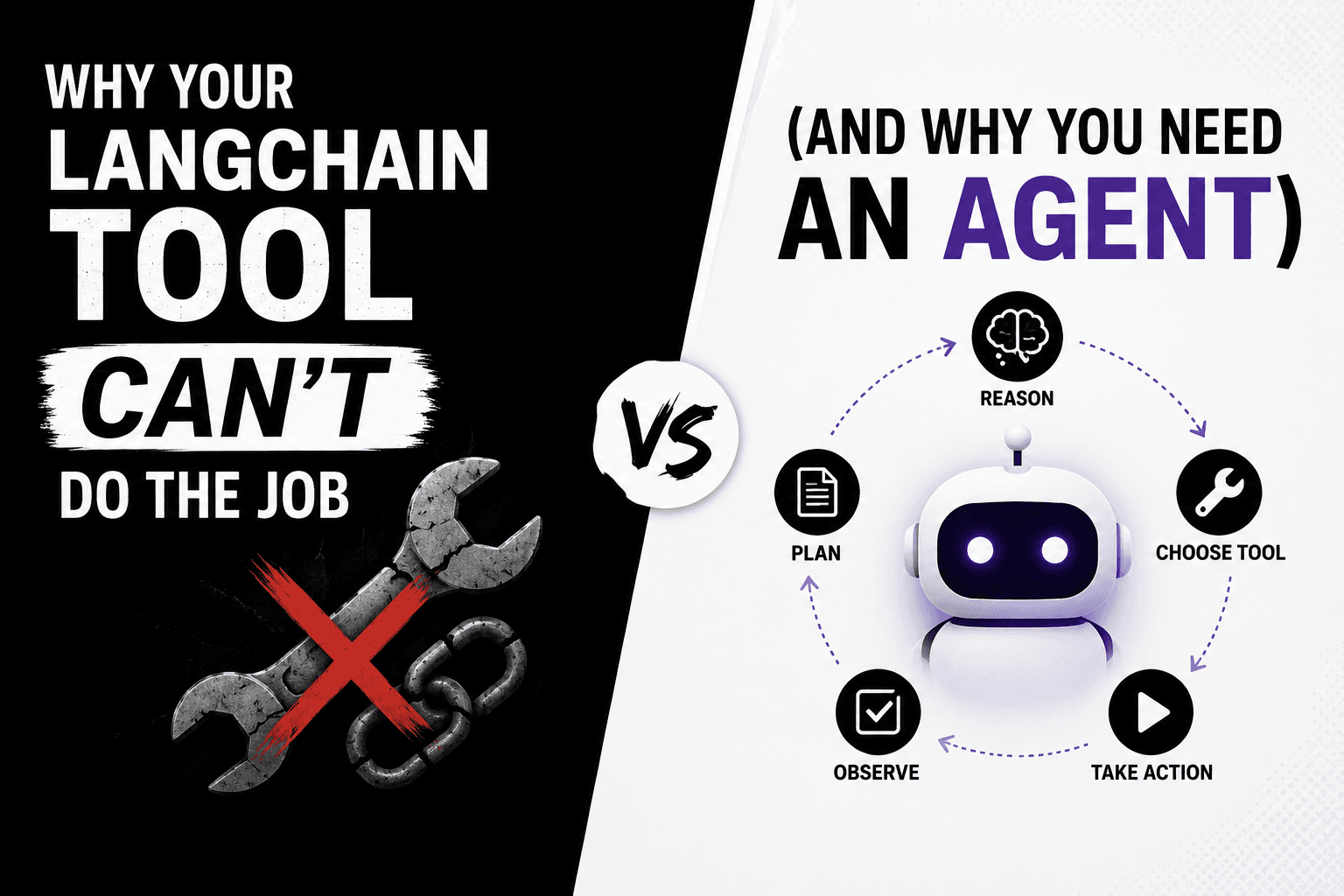
A Tool executes actions. An Agent decides which actions to execute.
This is the conceptual wall most beginners hit. Let me break it down.
What Is a Tool?
A Tool in LangChain is just a function, wrapped up so an LLM can use it. It exposes:
a name
a description
an input schema
an output
That's it.
For example:
@tooldefget_weather(city: str):
"""Returns weather for a city."""
...
Think of a Tool like a screwdriver sitting on a workbench. The screwdriver doesn't decide to build a table. It just waits for someone to pick it up.
The Biggest Misconception
I see this mistake all the time (and made it myself):
weather_tool.invoke("What's the weather in Delhi?")
or
weather_tool.run(...)
People expect the tool to magically understand natural language, reason about the request, and maybe even perform multiple steps.
It won't.
A Tool is not an AI assistant. It doesn't think, reason, or plan. It only executes.
Tools Have No Decision-Making Ability
Suppose you have three tools:
Weather Tool
Calculator Tool
Email Tool
Now, try to answer this user request:
"If it's going to rain tomorrow, email my manager that I'll work from home."
Who decides:
that weather info is needed?
to call the Weather Tool?
to check if "rain" is in the result?
to compose an email?
to call the Email Tool?
Certainly not the tools. Each tool knows only its own job.
This Is Where Agents Come In
An Agent is the "brain" of the operation.
Instead of directly executing functions, the Agent:
Instead, expose each capability as a separate Tool:
Generate PDF Tool
Upload File Tool
Send Email Tool
Update CRM Tool
Let the Agent orchestrate them.
Agents Think in Steps
Suppose a user asks:
"Summarize yesterday's sales and send the report to the finance team."
An Agent might reason like this:
Thought: I need yesterday's sales.
Action: QuerySalesTool
Observation: Sales data returned.

Thought: Now I should summarize it.
Action: LLM
Observation: Summary generated.

Thought: Now send the summary.
Action: EmailTool
Observation: Email sent.
This kind of reasoning loop is impossible if you're just invoking a single tool directly.
Tools Are Like APIs
Here's a useful analogy: REST APIs.
Your backend exposes endpoints like:
GET /users
POST /orders
GET /products
DELETE /cart
None of these endpoints decides the business workflow. Your frontend (or another backend service) orchestrates:
Fetch user
↓
Fetch cart
↓
Calculate price
↓
Create order
↓
Send notification
The APIs execute. The application orchestrates.
LangChain works the same way:
Tools execute.
Agents orchestrate.
Real-World Analogy: Building a House
Think of building a house. The workers are:
Electrician
Plumber
Carpenter
Painter
Each is highly skilled. But if you just gather them together, will a house magically appear? No.
Someone must coordinate:
who starts first
who comes next
when work is complete
what dependencies exist
That someone is the project manager.
In LangChain:
Workers = Tools
Project Manager = Agent
When Are Tools Alone Enough?
Tools are perfect when:
another system calls them directly
you already know exactly which function to execute
no reasoning is involved
there's only one step
Example:
calculate_tax(amount)
No AI required. Just execute it.
When Do You Need an Agent?
Reach for an Agent whenever the system needs to:
choose among multiple tools
reason before acting
perform multi-step workflows
react to intermediate results
decide dynamically what to do next
If the answer to "Which tool should I call?" depends on the user's request or on previous tool outputs, you almost certainly need an Agent.
Join the discussion
Nothing here yet — be the first to weigh in.